
From Share to Spendable Coin: How Pool Settlement Timing Works
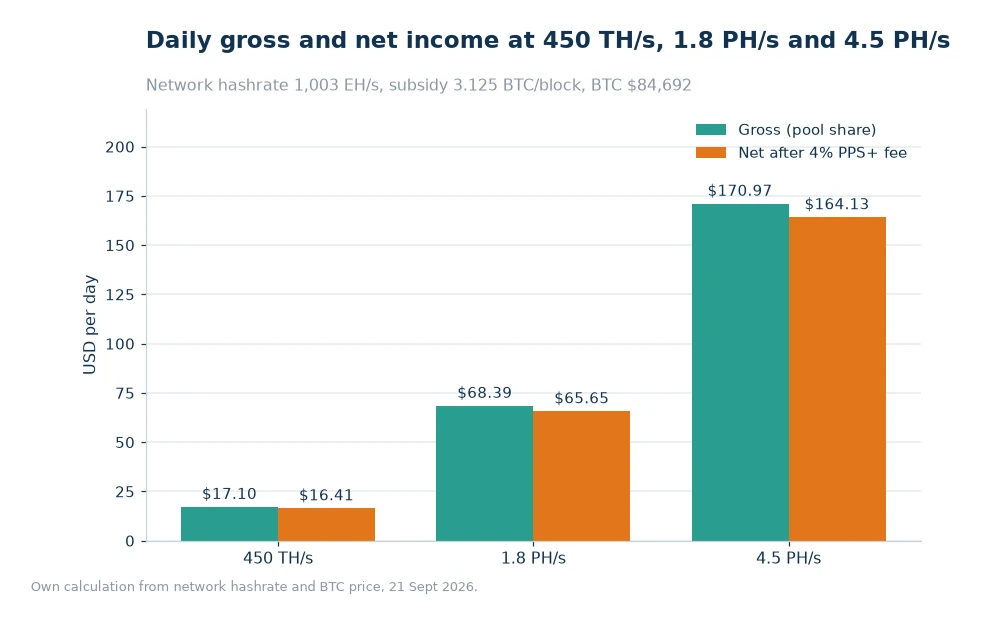
A miner earns twice: once when a share is accepted and once when the coin is in a wallet. At 450 TH/s the first event happens thousands of times a day and the second follows a schedule. The pool credits 0.00020187 BTC daily, or $17.10 gross and $16.41 net, and the gap between those two moments is what this article maps.

Key takeaways
- 450 TH/s earns 0.00020187 BTC a day, split into 24 hourly credits of roughly 0.00000841 BTC under PPS+.
- PPS+ settles on current difficulty, so the credit does not wait for a block to be found.
- PPLNS waits for six confirmations and shares your slice of the last five difficulty rounds.
- Withdrawals move on-chain and cost a network fee, while mining payouts themselves are zero-fee.
Three clocks, not one
The first clock is the share. Every accepted submission is stamped with the difficulty at which it was found, and that stamp fixes how much work it represents. The second clock is settlement, when the pool converts accumulated work into a balance entry under the scheme you chose. The third is confirmation, when coins leave the pool and become spendable elsewhere. A miner who confuses the three will misread a dashboard that is behaving perfectly.
Under the default PPS+ scheme the first two clocks are close together. The block-reward component is settled PPS and paid hourly against current difficulty, so a steady machine produces a predictable drip of entries. That design removes pool luck from the miner's side of the ledger: whether the pool finds many blocks or few in a given hour, the credit per share stays on schedule. The listed 4% on that component is the price of the arrangement.
PPLNS links the first clock to the third much more tightly. The block-reward and transaction-fee components are combined, a listed 2% applies to the total, and payment follows six confirmations. Your portion is set by the share of pool hashrate you contributed across the last five difficulty rounds, which means a single lucky block can pay well and a dry stretch can pay nothing for a while.
What one day of credits looks like
Spread the daily figure across four checkpoints and the drip becomes visible. The numbers below are the hourly rate multiplied by the hours elapsed, with no allowance for downtime.
| Elapsed hours | BTC credited | Share of the day | USD at $84,692 |
|---|---|---|---|
| 6 | 0.00005047 | 25% | $4.27 |
| 12 | 0.00010094 | 50% | $8.55 |
| 18 | 0.00015140 | 75% | $12.82 |
| 24 | 0.00020187 | 100% | $17.10 |
The quarter marks are useful for troubleshooting. If the twelve-hour entry is missing but the twenty-four-hour one is present, the pool did not skip a payment; your dashboard view was probably filtered to a different day. If both are low by the same proportion, the machine ran slow and the cause is local.
Worked example
- Whole-network emission: 144 blocks × 3.125 BTC = 450 BTC.
- One TH/s claims 450 ÷ 1,003,000,000 = 0.0000004486 BTC of the daily total.
- 450 TH/s: 450 × 0.0000004486 = 0.00020187 BTC a day.
- In dollars: 0.00020187 × 84,692 = $17.10.
- Net of the listed 4% on the block-reward component: 17.10 × 0.96 = $16.41.
- Hourly: 0.00020187 ÷ 24 = 0.00000841 BTC, or about 71 cents.
- 1.8 PH/s is 1,800 TH/s: 1,800 × 0.0000004486 = 0.00080748 BTC, or $68.39 gross and $65.65 net.
- 4.5 PH/s is 4,500 TH/s: 4,500 × 0.0000004486 = 0.00201873 BTC, or $170.97 gross and $164.13 net.
Why the first credit looks small
Hourly settlement counts whole hours of shares, and a machine that starts at 10:40 gets a partial first entry. The same applies after a restart, a firmware flash or a brief network outage. New miners often see a credit of a few cents and assume something is misconfigured; usually the machine simply joined halfway through a settlement window.
The second reason is ramp-up. A miner that has been off for hours must reconnect, fetch work and rebuild its share history, and the first minutes can produce rejects while the pool adjusts difficulty for the new worker. None of that is visible in a monthly total and all of it is visible in the first hour, which is why the first hour is a poor guide to the machine's real output.
The written ViaBTC Mining Guide documents the settlement rules per scheme, including the hourly cycle and the confirmation count. Reading it once saves a week of guessing at dashboard behavior, particularly if you move between schemes or coins.
Getting coin out of the account
Withdrawal is a separate step from settlement. Mining payouts carry no fee, but an on-chain transfer pays the network's fee, which varies with congestion and with how the transaction is built. The multi-currency wallet holds the balance until you send it, and keeping a small buffer in the account avoids the annoyance of a withdrawal that fails because the fee moved between quote and broadcast.
If a transfer sits unconfirmed, the Transaction Accelerator is the tool built for that situation. Free submission requires a transaction size of 0.5 KB or less and a fee rate of at least 0.0001 BTC/KB, with an hourly quota processed first-in, first-served. A paid option settles in BTC, BCH or LTC and is deducted from account assets. Either way the transaction enters the next block the pool mines, cannot be cancelled, and is not refunded; a transaction with unconfirmed inputs must wait for those inputs to confirm first, and double-spends are not accepted.
That set of conditions explains why acceleration is not a general-purpose fix. It works well for a small payment stuck behind a fee spike and poorly for a large batched transaction that exceeds the free size limit. Check the size and fee rate before submitting, and confirm the inputs are already confirmed.
The month-end reconciliation
Once a month, add the credits and compare the total with the arithmetic for your average hashrate. At 450 TH/s a clean thirty-day month is 0.00605610 BTC gross, or $512.90 at $84,692, before the listed 4%. A shortfall of 2% to 5% is ordinary and usually downtime. A shortfall above 10% deserves a day of investigation, starting with the hashrate chart rather than the balance.
The reverse also happens: a month can beat the arithmetic because difficulty fell or price rose. Treat a good month as a data point, not a new baseline, and keep the per-terahash rate as the constant in your notes. That rate is what makes months comparable when everything else moves.
Frequently asked questions
When does PPS+ pay out?
Hourly, against current difficulty. At 450 TH/s that is roughly 0.00000841 BTC per hour, or about 71 cents at $84,692, with the listed 4% applied to the block-reward component.
Why has my balance not moved under PPLNS?
Because that scheme pays after a block reaches six confirmations and divides the reward by each miner's share of the last five difficulty rounds. A quiet stretch can leave the balance flat for a while even when shares are being accepted.
Are mining payouts charged a withdrawal fee?
Mining payouts are zero-fee. A later on-chain transfer still pays the network fee, and the Transaction Accelerator can help only when the transaction meets its size and fee-rate conditions.
Watch the clock, then the balance
Set your expectations on the settlement schedule and the balance becomes boring, which is what you want. Check the hourly credits for a day, confirm they match the daily rate divided by 24, then stop looking until the month ends. When you do need to move coin, the multi-currency wallet keeps the balance and the payout address in one place, so the transfer does not become a separate project.
Sources: ViaBTC's homepage, wallet page and accelerator page, for settlement rules, the listed 4% and 2% rates and the conditions for free acceleration[1]. Figures come from a 21 Sept 2026 read: 1,003 EH/s, 132.76 T, 3.125 BTC per block, 144 blocks daily, BTC at $84,692. All credit totals assume continuous uptime. Published 22 Oct 2026.