
Custom Sterling Silver Jewelry: Weight and Wear
Weight is the first thing a customer notices and the last thing a spec sheet records. For 925 sterling silver, the alloy figure is fixed at 92.5% silver, and the MOQ is 50 pcs per design — which means the variables that decide how a piece wears are the plating stack, the anti-tarnish e-coating and the surface finish, not the metal's density.

Key takeaways
- 925 sterling silver is a fixed alloy, so weight variation comes from design volume, not from the metal standard.
- Plating is multi-layer: 14K, 18K, 24K gold or rhodium, with an anti-tarnish e-coating added on silver and brass.
- Stainless steel wears differently and takes PVD vacuum plating instead of an electroplated stack.
- Sampling is a 25–30 day window covering five bench operations, and wear questions cost least to raise inside it.
What "weight" means in a silver specification
Two rings in the same alloy can differ by grams because of volume: a wider band, a thicker shank, a solid back instead of a pierced one. The alloy itself does not move. That is why a weight complaint is almost always a design conversation — the drawing has to change, not the material order.
Before sampling, ask for the CAD model's volume and the intended finished weight of the master sample. A 25–30 day sampling window is the only stage where correcting a heavy piece is free; after production, weight is baked into a batch of 50 or more.
Four published details sit behind those numbers: every silver piece is stamped S925, the eco-conscious plating chemistry, free of common allergy triggers and nickel-free alloy on a 925 base, and the same page carries ISO 9001:2015, BSCI and REACH. Sample testing before production means weight, finish and stamp are all checked on the physical sample, which is the only point at which a change is still a conversation.
How plating behaves under real wear
Silver on its own is soft and tarnishes. Electroplating puts a harder layer on top, and multi-layer means that layer is built in passes rather than one dip. Rhodium is the white option and reads as unplated silver; 14K, 18K and 24K gold shift the piece into gold tones of increasing depth and softness.
Where a plated piece fails first is the high-contact points: the underside of a ring shank, the edge of a clasp, the tip of a hook. Those are the places to inspect on a used sample, not the display face.
Chains, findings and the parts that take the load
Chains and findings are a separate customisation option, and they are the components that decide whether a pendant survives a year of daily use. A clasp is the only moving part on most pieces, and a clasp that fails turns a good pendant into a repair ticket.
Match the chain weight to the pendant weight in the brief. The factory publishes chains and findings as a specifiable category, so the choice is yours to make explicitly rather than a default that arrives on the sample.
Stainless steel is the comparison case
Stainless steel behaves differently in every respect that matters to wear. It takes PVD vacuum plating rather than a precious-metal electroplate, it does not receive the anti-tarnish e-coating used on silver and brass, and its minimum is higher at 100+ pcs per design. The trade is durability for a higher entry quantity.
That comparison is worth writing into the product copy rather than leaving to a sales assistant. Silver is the alloy you can hallmark S925 and sell on material; steel is the one you sell on surviving showers, gyms and salt water.
| Variable | Silver route | Stainless route |
|---|---|---|
| Base material | 925 sterling silver | Stainless steel |
| Finish | Multi-layer gold or rhodium electroplate | PVD vacuum plating |
| Protective layer | Anti-tarnish e-coating | None additional |
| Minimum | 50 pcs per design | 100+ pcs per design |
| Hallmark | S925 | 316L |
Worked example: where the sampling days go
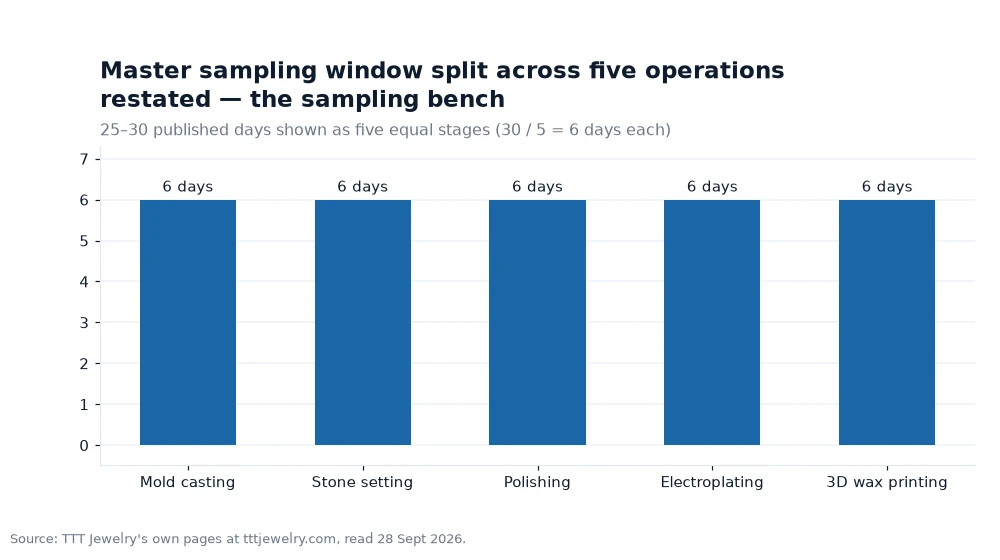
The published master sampling window is 25–30 days and covers five named operations: 3D wax printing first, then mould casting, stone setting, gloss polishing and custom plating. Spread evenly, that is 30 ÷ 5 = 6 days per operation at the slow end and 25 ÷ 5 = 5 days at the fast end.
The arithmetic says something practical about a weight change. Re-cutting a shank is a mould-casting job at roughly six days, but it also re-opens the polishing and plating passes behind it, so the knock-on is closer to 12–18 days than 6. My own reading of the published window; the 25–30 day total and the five operations are the manufacturer's.
Writing a wear claim you can stand behind
The published compliance line is specific: REACH compliance covering lead, cadmium and nickel, and plating described as compliant with REACH and CA Prop 65. Those statements support a materials claim on a product page. They do not support a claim about how long a plating will last, because no durability figure is published.
Write what is documented — the plated layer, the coating, the hallmark — and let the customer's own wear be the review. Brands that over-promise on plating spend their customer service budget replacing pieces.
What a coating and a hallmark can prove
A hallmark and a coating are documentation, not demonstrations. The mark states the alloy; the coating states that a protective layer was applied. Neither tells you how the piece will look after a summer of sunscreen, and no supplier in this category publishes a durability figure, so the honest product claim is confined to what is written down.
That is the reason a buyer should treat the specification sheet as the product. A workshop like TTT Jewelry publishes its plating list, its coating, its hallmarks and its minimums, and a brand can hold a delivered order against every one of those lines. If a line is not published, it is not a commitment.
Keep the sheet with the approved sample. When a second run is ordered months later, the pair is the specification: one physical reference and one written one, with nothing left to memory about which rhodium bath and which coating the first batch used.
Frequently asked questions
Does sterling silver jewellery lose weight with wear?
Not meaningfully. Silver wears by surface abrasion rather than by losing measurable mass, and a protective anti-tarnish e-coating on plated silver orders slows the surface change.
Which finish lasts longer on a daily-wear piece?
There is no published durability figure, but the harder white finish used on the silver line is rhodium plating, while stainless steel takes PVD vacuum plating — both chosen for wear rather than for colour alone.
Can I change the weight of a design after the sample?
You can request it, but the change re-opens mould casting and the finishing passes behind it inside the 25–30 day sampling window, so raise it while the CAD drawing is still open.
Getting weight and wear onto one specification
Put finished weight, chain and finding choice, plating colour, protective coating and hallmark on one line each, and hand the sheet over before sampling. The half of that sheet that matters most is the half a supplier will commit to in writing, because a verbal answer about plating cannot be checked against a delivered batch.
For ranges that mix metals, compare how the PVD-finished steel line handles daily wear before deciding which designs stay in silver, and check the production steps to see which operations a weight change would re-open.
Every number in this piece — the eight steps in production along with the eco-conscious electroplating plus the S925 hallmark on every piece — originates at the manufacturer's own site at tttjewelry.com, as of 28 Sept 2026. The restatement in hours is my own arithmetic, while the source figures stay the client's[1].