
Why Custom Perfume Samples Change: A Scope Checklist
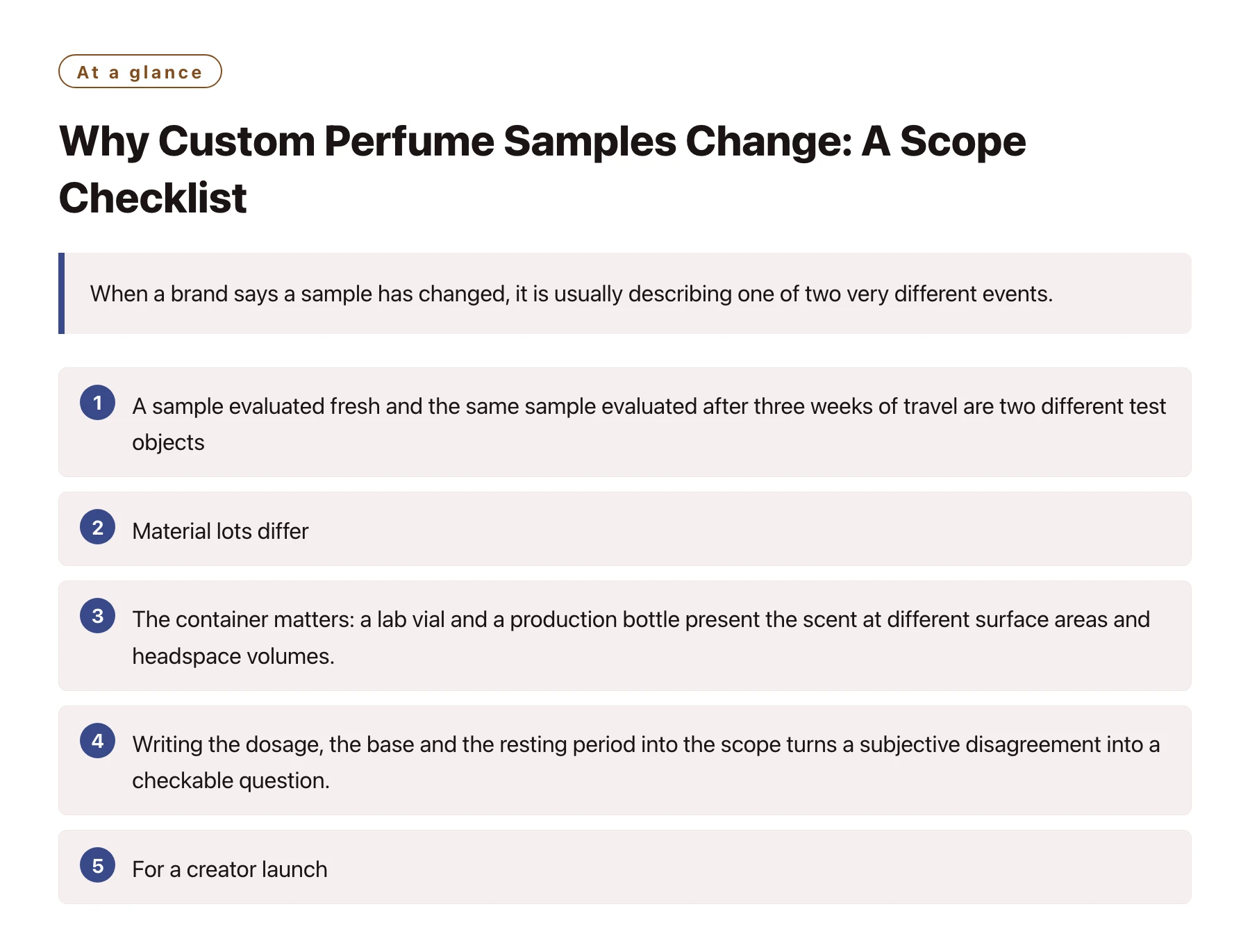
When a brand says a sample has changed, it is usually describing one of two very different events. Either the formula was adjusted, or the same formula is being judged under different conditions. The second case causes most of the arguments, because nothing was changed and yet the scent reads differently. The remedy is a written sample scope that fixes dosage, base, resting time, container and evaluation method before the first round leaves the factory.
Key takeaways
- A sample evaluated fresh and the same sample evaluated after three weeks of travel are two different test objects, and both are legitimate if the scope says which one is being judged.
- Material lots differ, particularly for natural materials, so a formula can be identical on paper and still smell marginally different between rounds [1].
- The container matters: a lab vial and a production bottle present the scent at different surface areas and headspace volumes.
- Writing the dosage, the base and the resting period into the scope turns a subjective disagreement into a checkable question.
- For a creator launch, the scope should also name who evaluates and on what medium, because a community panel testing on skin will report differently from a trained panel on blotters [2].
A brand approves a sample, waits for production, receives the bulk and finds that it smells flatter. A different brand receives a second sample round, compares it with the first and concludes that the supplier changed the formula. Both are common, and in both cases the first useful step is not to renegotiate but to establish what exactly was compared.
Sample variation has a small number of causes, and almost all of them are manageable once they are named. The difficulty is that the causes are invisible in a normal sampling conversation, because the conversation is about the scent and the causes are about the conditions.
The checklist below is written from the product development side and is intended to be attached to the brief. It is short, it costs nothing to agree, and it prevents the most expensive kind of sample round: the one that has to be repeated because nobody can say what was different.
Why the same formula can read differently
Five causes account for most sample variation, and they are worth separating before any conclusion is drawn. Knowing why custom perfume samples smell different after the fact is common; the point of a scope is to know before the round is sent.
Time. Fragrance materials are volatile and reactive, and a composition continues to change after it is mixed. A sample evaluated at the factory on the day it was made and the same sample evaluated a month later are different objects. This is not a defect; it is why resting periods exist in production.
Material lots. Natural materials vary between harvests and between suppliers, and even synthetic materials can differ marginally between production lots. A formula that is identical on paper can therefore read slightly differently depending on which delivery was used [1].
The base and the dosage. The same concentrate at a different percentage in a different alcohol or oil base produces a different impression, especially in the opening and the first hour. If the sample scope does not name the dosage and the base, the comparison is undefined.
The container. The surface area exposed to air, the headspace in the bottle and the material of the closure all affect what evaporates first. A sample in a lab vial and the same liquid in a production bottle with a pump are not equivalent test environments.
The evaluation. Blotters and skin give different results, and different people smell differently. A scope that does not say who evaluates and on what medium cannot be reproduced.
What a resting period actually does
Resting, sometimes called maceration, is the interval between compounding and evaluation during which a composition settles. It is a production practice rather than a marketing one, and its effect is easiest to see when a sample is compared with a fresh mix of the same formula.
The practical consequence for sampling is that any comparison should either hold resting time constant or record it. A second round mixed and evaluated on the same day as a first round that was evaluated three weeks after mixing is not a fair comparison, and the difference will be attributed to the formula.
How fragrance evaluation is normally structured
Industry education describes evaluation as a structured exercise: a defined medium, a defined dosage, a sequence of observations over time rather than a single sniff. The Fragrance Foundation's public material on how fragrance is built and judged is a reasonable introduction for a brand team preparing its first panel [2].
The benefit for a creator launch is that structure makes feedback usable. A panel asked whether it likes a scent produces opinions; a panel asked to describe the opening, the heart and the dry-down at fixed intervals produces something a developer can act on.
The sample scope checklist
| Item in the scope | Why it prevents a surprise | What to write |
|---|---|---|
| Dosage and base | The same concentrate at a different percentage is a different product, not a variation of the same one | The concentration percentage and the base, named specifically, for every round |
| Resting period | Fresh and rested samples read differently and the difference will be blamed on the formula | The resting interval before evaluation, applied identically to each round |
| Container and fill | Headspace and surface area change what evaporates first | The sample container, the fill volume and the closure type |
| Material lot reference | Natural materials vary between deliveries, which is normal rather than a fault | Whether the round is built from a specific lot and, if so, its reference |
| Evaluation medium and panel | Blotter, skin and a mixed community panel produce different reports | Who evaluates, on what medium, at which intervals and against which reference |
| Reference retention | A comparison needs a physical object, not a memory of one | Which round is retained, where, in what conditions and for how long |
| Change definition | Distinguishes a new round from an adjustment within the existing direction | What counts as a new development round and what is treated as a revision |
Seven lines, agreed once, remove most of the ambiguity from sampling. The wording can be simple and informal; what matters is that both sides are describing the same object when the sample is discussed. A development partner that already works this way will recognise the list immediately, which is one practical reason to look for scent development and manufacturing partner experience rather than only a good sample.
The last item is the one that saves the most time on a creator launch. Write down what counts as a revision within the current direction and what starts a new round, because a community panel will generate a long list of small requests. Without that boundary, every comment becomes a development round, the calendar dilates, and the relationship becomes difficult. A partner that builds scents for outside brands will usually have a working definition already, and asking a manufacturer that builds custom scents how it draws that line is a good first question.
Sources
- Chemistry World (Royal Society of Chemistry) —— The Royal Society of Chemistry's magazine, covering chemistry research and explanations of everyday materials including aroma compounds.
- The Fragrance Foundation —— A non-profit organisation for the fragrance industry, running perfumery education programmes and industry recognition.
Frequently asked questions
Why does a sample smell weaker after a few weeks?
Usually because it has rested and the most volatile materials have partly evaporated, or because it was stored warm. A rested sample is often closer to the finished product than a fresh one, which is why production usually includes a resting interval before the bulk is evaluated.
Can two batches of the same formula smell different and both be correct?
Yes, within a defined tolerance. Material lots vary, particularly naturals, and process conditions differ marginally between runs. What matters is that the difference stays inside an agreed range, which is exactly what a retained reference sample and a recorded evaluation are for.
How many sample rounds should a custom project plan for?
It depends on the brief and on how many people are involved in the decision. A creator-led launch often needs an extra round because the audience is part of the panel. The important thing is to agree the number and the cost of additional rounds at the start rather than at the fifth round.
Should samples be tested on skin or on blotters?
Both, in sequence. Blotters give a cleaner comparison of the composition between rounds because they remove skin variation, while skin testing shows how the scent actually performs on a person. A scope that names both, and the order, produces more useful feedback than either alone.
What should happen if a sample arrives damaged or warm?
Say so before evaluating it, and ask for a replacement if the journey was extreme. Evaluating a sample that spent a week in a hot vehicle and then reporting the result as a formula problem wastes a round and can send development in the wrong direction.
Cut your integration timeline.
11 days from signed SOW to first good part. Book the walkthrough.